

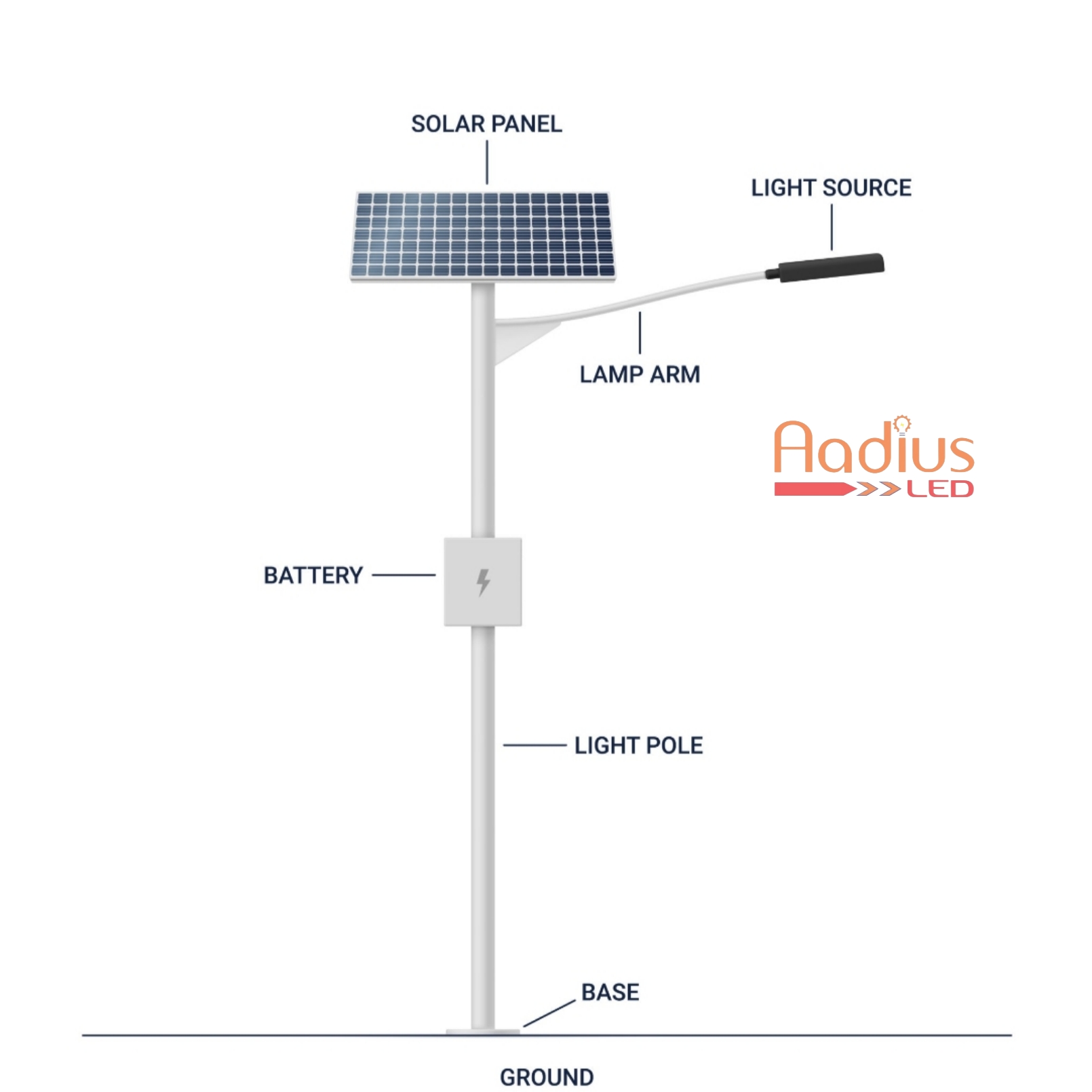
Introduction to Lead-Acid Batteries
The Lead-Acid Battery is a traditional and cost-effective energy storage solution that was widely used in early solar street light installations. They are favored for their reliability and low initial cost. For solar applications, a Deep Cycle type of lead-acid battery is typically used, as they are designed to be repeatedly discharged and recharged deeply.
🛠️ Key Characteristics (VRLA Type)
The most common type used in modern solar street lights are VRLA (Valve Regulated Lead-Acid) batteries, which are maintenance-free. These include:
* AGM (Absorbent Glass Mat): The electrolyte is absorbed into fiberglass mats, making the battery spill-proof.
* Gel: The sulfuric acid electrolyte is mixed with fumed silica to form a gel-like substance, which reduces evaporation and corrosion, often leading to a better cycle life than AGM in deep-cycle applications.
* Voltage: They are commonly available in 12V or 24V configurations.
* Capacity: Measured in Ampere-Hours (Ah), which determines how long the light can run when the sun isn't shining.
⚡ Performance and Limitations
* Life Span: Their typical lifespan is around 3 to 5 years, which is significantly shorter than modern lithium-ion batteries.
* Depth of Discharge (DOD): To maximize their life, they should ideally not be discharged below 50% of their capacity. Deeper discharges shorten their cycle life considerably.
* Efficiency: They have lower charge/discharge efficiency (around 80-85%) compared to lithium batteries.
* Energy Density: They have a low energy density (approx. 30 to 50 Wh/kg), meaning they are heavier and bulkier than lithium-ion batteries for the same storage capacity. This requires a larger enclosure or a ground-level battery box for street lights.
* Temperature Sensitivity: Performance and lifespan can be negatively affected by extreme temperatures.
💡 Current Usage
While reliable, lead-acid batteries are being largely replaced in new solar street light installations by Lithium Iron Phosphate (LiFePO4) batteries due to the latter's longer lifespan, higher efficiency, lighter weight, and zero-maintenance requirements. Lead-acid batteries may still be chosen for budget-constrained projects where the size and weight are not critical factors.
The Lead-Acid Battery is a traditional and cost-effective energy storage solution that was widely used in early solar street light installations. They are favored for their reliability and low initial cost. For solar applications, a Deep Cycle type of lead-acid battery is typically used, as they are designed to be repeatedly discharged and recharged deeply.
🛠️ Key Characteristics (VRLA Type)
The most common type used in modern solar street lights are VRLA (Valve Regulated Lead-Acid) batteries, which are maintenance-free. These include:
* AGM (Absorbent Glass Mat): The electrolyte is absorbed into fiberglass mats, making the battery spill-proof.
* Gel: The sulfuric acid electrolyte is mixed with fumed silica to form a gel-like substance, which reduces evaporation and corrosion, often leading to a better cycle life than AGM in deep-cycle applications.
* Voltage: They are commonly available in 12V or 24V configurations.
* Capacity: Measured in Ampere-Hours (Ah), which determines how long the light can run when the sun isn't shining.
⚡ Performance and Limitations
* Life Span: Their typical lifespan is around 3 to 5 years, which is significantly shorter than modern lithium-ion batteries.
* Depth of Discharge (DOD): To maximize their life, they should ideally not be discharged below 50% of their capacity. Deeper discharges shorten their cycle life considerably.
* Efficiency: They have lower charge/discharge efficiency (around 80-85%) compared to lithium batteries.
* Energy Density: They have a low energy density (approx. 30 to 50 Wh/kg), meaning they are heavier and bulkier than lithium-ion batteries for the same storage capacity. This requires a larger enclosure or a ground-level battery box for street lights.
* Temperature Sensitivity: Performance and lifespan can be negatively affected by extreme temperatures.
💡 Current Usage
While reliable, lead-acid batteries are being largely replaced in new solar street light installations by Lithium Iron Phosphate (LiFePO4) batteries due to the latter's longer lifespan, higher efficiency, lighter weight, and zero-maintenance requirements. Lead-acid batteries may still be chosen for budget-constrained projects where the size and weight are not critical factors.