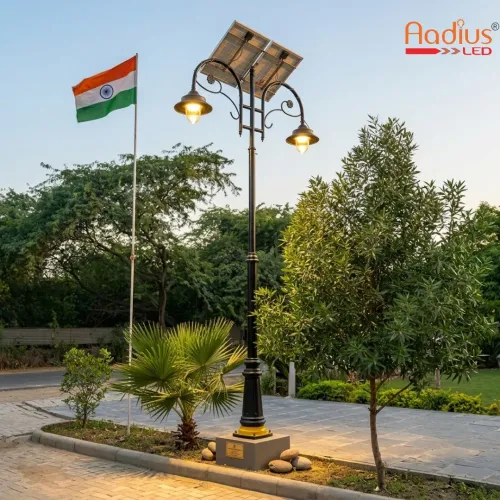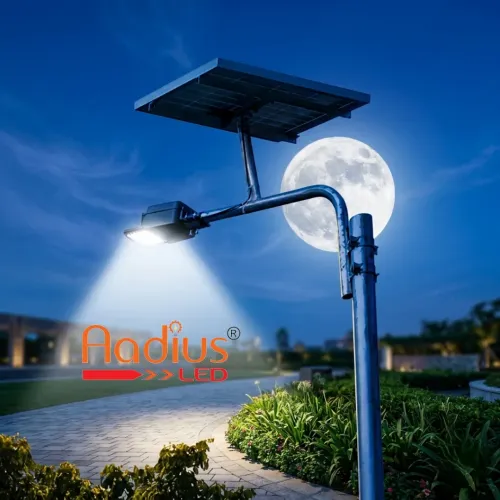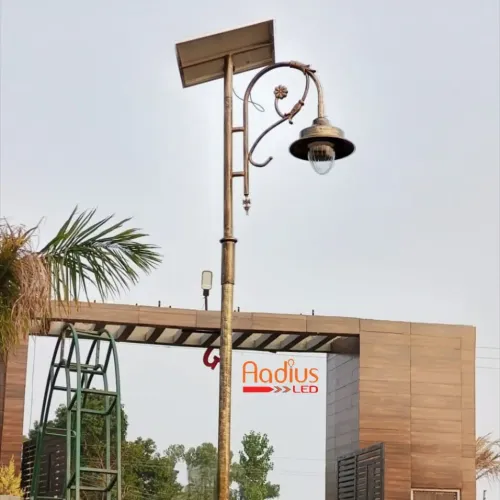



Solar street lights are standalone outdoor lighting systems that harvest energy from the sun to provide dependable illumination without relying on the conventional power grid.
1. Core Components
A high-performance solar street light relies on five main interconnected parts:
Solar PV Module (Solar Panel): Converts photons from sunlight into Direct Current (DC) electricity using the photovoltaic effect. High-efficiency monocrystalline panels are preferred over polycrystalline versions because they capture more energy in a smaller footprint, even on cloudy days.
Rechargeable Battery: Stores the converted electricity during daylight hours for nighttime use. Modern configurations use Lithium Iron Phosphate (LiFePO_4) or Lithium-ion batteries. They offer a much longer cycle life (up to 5 to 10 years) and higher depth of discharge compared to traditional lead-acid variants.
LED Luminaire: The actual light source. Light Emitting Diodes (LEDs) are highly energy-efficient, drawing significantly less wattage while outputting high lumens (typically 130 to 170+ lumens per watt).
Smart Charge Controller: The "brain" of the fixture. It regulates the voltage and current going into the battery to prevent overcharging or deep discharging. Modern setups utilize Maximum Power Point Tracking (MPPT) controllers, which optimize energy harvest by up to 20–30% over basic PWM (Pulse Width Modulation) units.
Pole & Mounting Brackets: Heavily galvanized structures designed to withstand high wind loads, elevating the system to the proper height.
2. Working Principle
The entire operation relies on automated automation divided into a clear day-and-night cycle:
Day Phase (Charging)
Sunlight hits the solar cells on the panel.
The silicon layers absorb photons, creating an electrical current.
The smart controller channels this current into the storage battery.
1. Core Components
A high-performance solar street light relies on five main interconnected parts:
Solar PV Module (Solar Panel): Converts photons from sunlight into Direct Current (DC) electricity using the photovoltaic effect. High-efficiency monocrystalline panels are preferred over polycrystalline versions because they capture more energy in a smaller footprint, even on cloudy days.
Rechargeable Battery: Stores the converted electricity during daylight hours for nighttime use. Modern configurations use Lithium Iron Phosphate (LiFePO_4) or Lithium-ion batteries. They offer a much longer cycle life (up to 5 to 10 years) and higher depth of discharge compared to traditional lead-acid variants.
LED Luminaire: The actual light source. Light Emitting Diodes (LEDs) are highly energy-efficient, drawing significantly less wattage while outputting high lumens (typically 130 to 170+ lumens per watt).
Smart Charge Controller: The "brain" of the fixture. It regulates the voltage and current going into the battery to prevent overcharging or deep discharging. Modern setups utilize Maximum Power Point Tracking (MPPT) controllers, which optimize energy harvest by up to 20–30% over basic PWM (Pulse Width Modulation) units.
Pole & Mounting Brackets: Heavily galvanized structures designed to withstand high wind loads, elevating the system to the proper height.
2. Working Principle
The entire operation relies on automated automation divided into a clear day-and-night cycle:
Day Phase (Charging)
Sunlight hits the solar cells on the panel.
The silicon layers absorb photons, creating an electrical current.
The smart controller channels this current into the storage battery.