

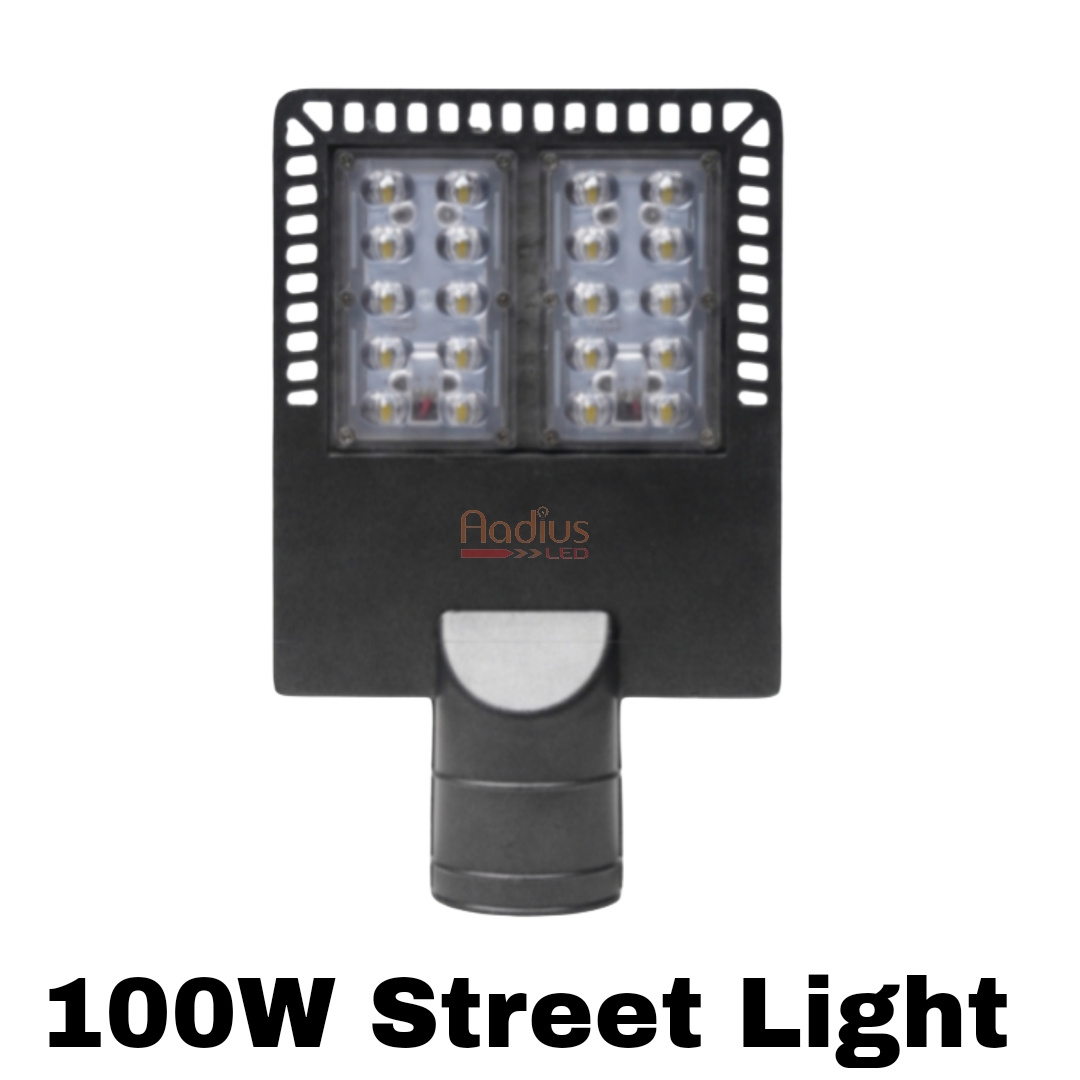
100W Street Light utilizing 5050 LEDs is a powerful, energy-efficient outdoor lighting solution.
Here is a general description based on common specifications found for this type of fixture:
💡 100W 5050 LED Street Light Description
This fixture is designed as a high-performance replacement for older, less efficient street lighting technologies, ideal for illuminating roads, highways, parks, and general urban areas.
Key Features & Technology:
* Power & Brightness: Rated at 100 Watts (W), these lights offer substantial illumination. The light output (Luminous Flux) typically ranges significantly depending on the LED efficacy, often providing 14,000 to 17,000+ lumens (lm).
* LED Chip Type: It utilizes 5050 SMD (Surface Mount Device) LEDs. The "5050" designation refers to the chip's size (5.0 mm x 5.0 mm), which generally allows for high brightness output from a single chip. Some models may also incorporate other chip types like 2835 alongside the 5050s.
* Housing & Durability: The body is typically constructed from Aluminum (often die-cast) to serve as an excellent heat sink, which is crucial for dissipating the heat generated by the powerful LEDs and ensuring a long operational life.
* Protection Rating (IP Rating): They usually have a high IP rating, most commonly IP65 or IP66. This signifies robust protection against dust ingress and resistance to water jets from any direction, making them perfectly suitable for permanent outdoor installation.
* Color Temperature (CCT): Available in various color temperatures to suit different needs, such as:
* Cool White (often approx 6000\K to 6500K) for high visibility.
* Warm White (often \approx 3000K to 4000K) for a softer look.
* Lifespan & Efficiency: These lights are known for a very long service life, often rated for 50,000 hours or more (L70). They provide significant energy savings compared to traditional High-Pressure Sodium (HPS) or Mercury Vapor lamps.
* Optics: Often include a polycarbonate lens or tempered glass cover designed to distribute the light over a specific area (e.g., Type II or Type III beam angle) to maximize road coverage and minimize light pollution.
* Input Voltage: Typically designed to operate on standard AC mains voltage, such as 100-305V AC.
Here is a general description based on common specifications found for this type of fixture:
💡 100W 5050 LED Street Light Description
This fixture is designed as a high-performance replacement for older, less efficient street lighting technologies, ideal for illuminating roads, highways, parks, and general urban areas.
Key Features & Technology:
* Power & Brightness: Rated at 100 Watts (W), these lights offer substantial illumination. The light output (Luminous Flux) typically ranges significantly depending on the LED efficacy, often providing 14,000 to 17,000+ lumens (lm).
* LED Chip Type: It utilizes 5050 SMD (Surface Mount Device) LEDs. The "5050" designation refers to the chip's size (5.0 mm x 5.0 mm), which generally allows for high brightness output from a single chip. Some models may also incorporate other chip types like 2835 alongside the 5050s.
* Housing & Durability: The body is typically constructed from Aluminum (often die-cast) to serve as an excellent heat sink, which is crucial for dissipating the heat generated by the powerful LEDs and ensuring a long operational life.
* Protection Rating (IP Rating): They usually have a high IP rating, most commonly IP65 or IP66. This signifies robust protection against dust ingress and resistance to water jets from any direction, making them perfectly suitable for permanent outdoor installation.
* Color Temperature (CCT): Available in various color temperatures to suit different needs, such as:
* Cool White (often approx 6000\K to 6500K) for high visibility.
* Warm White (often \approx 3000K to 4000K) for a softer look.
* Lifespan & Efficiency: These lights are known for a very long service life, often rated for 50,000 hours or more (L70). They provide significant energy savings compared to traditional High-Pressure Sodium (HPS) or Mercury Vapor lamps.
* Optics: Often include a polycarbonate lens or tempered glass cover designed to distribute the light over a specific area (e.g., Type II or Type III beam angle) to maximize road coverage and minimize light pollution.
* Input Voltage: Typically designed to operate on standard AC mains voltage, such as 100-305V AC.